Get in Touch
Contact our team today - here to help 24/7

Call Us 24/7 On 0808 159 1403 or Contact Us Online
An outbreak of an infectious viral or bacterial disease can happen anywhere, from schools and offices to healthcare environments, such as hospitals and care homes. Infectious diseases and viruses can pose serious threats to the health and wellbeing of staff, customers, residents and members of the public, and are spread via numerous routes.
Rentokil Specialist Hygiene offers a range of disinfection services to help minimise the risk of infection and to assist with the control and containment of outbreaks. We provide a rapid response within the hour to viral emergencies for the whole of the UK, 24/7.
Ranging from a mild cold to far more serious threats, infectious diseases are an inevitable fact of life. How much of an impact they have on us though, can be significantly limited by controlling their spread as quickly and effectively as possible. Taking rapid action to contain illnesses such as Flu and Norovirus reduces the number of people who are infected, protecting staff, patients and customers, and improving absenteeism. Professional cleaning and disinfection demonstrates care for employee health and wellbeing, and is a vital part of day to day infection control and patient care within hospitals and other clinical environments.
In the UK, all employers have a general duty to ensure the health and safety of their employees under the Health and Safety at Work Act 1974, with effective infection control cleaning forming a key part of this legislation. For healthcare settings, under the Health and Social Care Act 2008, healthcare providers must meet codes of practice for infection prevention and control, with action taken by bodies like the Care Quality Commission (CQC) for non-compliance.
Beyond the regulatory aspect, lacking a robust procedure for infection control can result in significant financial implications. This is seen through lost time, increased absenteeism, additional cleaning costs and premise down time. Moreover, poor virus containment and control can severely affect your reputation. With time being of the essence in minimising spread, knowing how to respond when your premise is affected by diseases such as Norovirus can save precious time and money.
Viral transmission from one person to the next generally occurs by one two routes:
Airborne - when we cough or sneeze, or even just breathing, we release thousands of airborne droplets of moisture. If we have a respiratory infection, these droplets become infectious and carry virus and bacteria through the air from person to person.
Surface-borne - when airborne droplets land, or when we touch a surface with contaminated skin, infectious bacteria and viruses are left behind for the next person to come into contact with them. Bacteria in particular can survive on surfaces for hours, even days. Common touchpoints in buildings such as door handles, shared desks or communal equipment quickly become a melting pot of pathogenic material, just waiting for a new host to touch the same place.
Regular and thorough cleaning will limit the spread of germs, but specialist virus containment cleaning and disinfection will destroy viruses and bacteria present, disrupting the chain of infection. Once a bug such as Norovirus has become established in a building, effective containment by specialised disinfection teams using the correct PPE and equipment is essential in avoiding unnecessary exposure of staff, patients and customers alike.
Following an infectious disease outbreak, increasing the frequency and intensity of cleaning is crucial for preventing further spread. Regular, routine cleaning helps prevent illness from becoming established within the building, but once present, a more aggressive approach is needed when an outbreak occurs.
Destroying disease-causing bacteria and viruses on surfaces effectively requires a number of key elements:
A rapid response - keeping the number of infected individuals as low as possible is essential. By quickly identifying and controlling an outbreak, eradication is made much easier.
Experience and knowledge of infection control cleaning methods - utilising RSPH-trained technicians identifying key touch points and surfaces to focus on is essential for breaking the chain.
Specialist PPE and equipment - PPE (personal protective equipment) provides direct protection against the very pathogens being treated and is vital in keeping everyone safe. Combine this with cutting edge disinfection and application equipment, and medical-grade chemical disinfectants, and effective control is far more achievable.
Regular cleaning - once a disease has been contained and the affected environment treated, regular cleaning protocols help ensure that it cannot become reestablished easily.
Our team of specialist disinfection technicians are trained to Royal Society for Public Health (RSPH) accredited standards, ensuring our consistency and quality of service, knowledge, expertise and professionalism throughout the UK. By insisting on all of our staff holding recognised qualification we always provide the highest quality of service, no matter what the emergency.
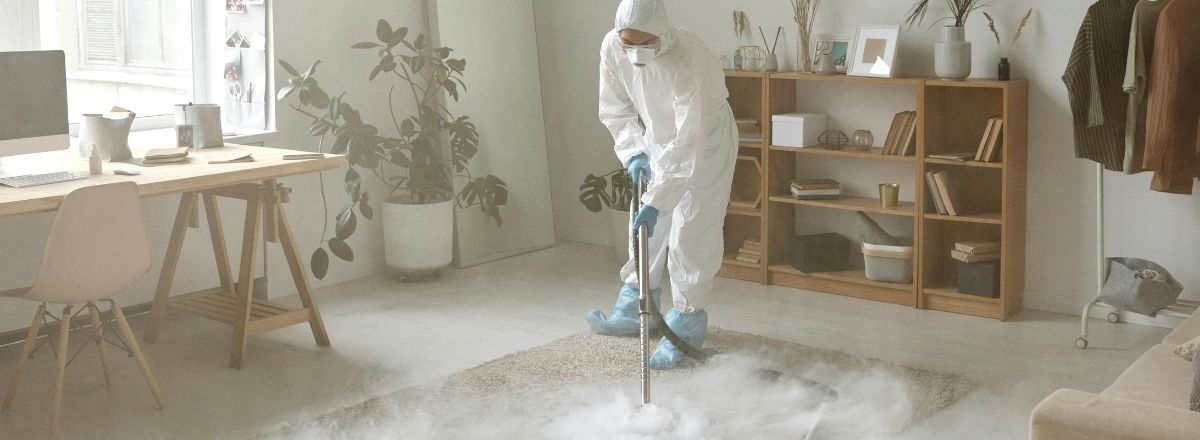
A thorough, professional, deep cleaning infection control programme starts as soon as you pick up the phone. We will attend quickly, within the hour if required, to assess and isolate the area before commencing work. We will then work through the building or area, methodically cleaning and disinfecting touchpoints and surfaces as they go, using techniques and equipment relevant to the job at hand.
Typically, the most effective way of treating is to apply a liquid chemical disinfectant. Our powerful antiviral disinfection chemicals kill up to 99.9999% of bacteria and viruses within minutes*, leaving all treated surfaces clean and hygienic.
Once we have thoroughly disinfected, we ensure the treated area is handed back safely and remove and dispose of any PPE and waste in line with correct protocols and national waste legislation.
*Steri7
Hundreds of different infectious diseases occur every year in the UK, at one point or another affecting all of us. Some of the more common ones we often encounter are:
commonly known as the winter vomiting bug
Noroviruses are a group of viruses that are one of the most common stomach bugs in the UK and cause intestinal flu. This virus is transferred from person to person via contaminated food or water. It is highly contagious and can affect people of all ages. Over 600,000 people in the UK catch Norovirus each year*. Symptoms include a sudden feeling of sickness followed by vomiting and watery diarrhoea. The symptoms will start to appear 1-2 days after infection; most people will fully recover within a few days.
*NHS England and NHS Wales
Escherichia coli
Typically associated with gastrointestinal infections and dehydration. The most common way of catching this bacterial infection is by eating food contaminated with animal faeces. People infected with E. coli are highly contagious, if an individual does not wash their hands properly after going to the bathroom the bacteria can be passed to other people. Generally symptoms will occur 7 days after the initial infection and include abdominal cramps, sickness and vomiting and diarrhoea.
Clostridium Difficile
C. Diff is a bacterium which lives naturally in the gut of around 3% of adults. The bacteria produces spores that are resistant to high temperatures and are very difficult to eliminate. Spores can remain in the environment on clothes, bedding etc for several months or even years.
This virus is spread through contaminated food and objects where individuals have not washed their hands properly. C. Diff doesn't cause problems in healthy people, however if the number of bacteria greatly increases complications can occur. Once the infection spreads it creates toxins which then attack the lining of the intestines. C. Diff often becomes a problem after taking antibiotics for other health conditions which is why most cases happen in a healthcare environment.
Methicillin-resistant Staphylococcus aureus
In hospitals, MRSA is one of the most recognised superbugs around. This type of infection gets into the body through breaks in the skin causing an abscess, boils, impetigo and if it gets into the bloodstream, blood poisoning. It is very difficult to treat with antibiotics because by definition, it is a bacterium which has developed resistance to certain types of antibiotics, meaning it can be deadly to infected individuals.
The bacterium can be carried on a healthy person without their knowledge and with no symptoms. However, when in hospital a patient's immune system is weaker, making them prone to infection and contracting MRSA as a result. The mortality rate for an infected person with MRSA is 35%.
Coronavirus
Coronavirus disease (COVID-19) is an infectious disease caused by the SARS-CoV-2 virus.
Most people infected with the virus will experience mild to moderate respiratory illness and recover without requiring special treatment. However, some will become seriously ill and require medical attention. Older people and those with underlying medical conditions like cardiovascular disease, diabetes, chronic respiratory disease, or cancer are more likely to develop serious illness. Anyone can get sick with COVID-19 and become seriously ill or die at any age.
Transmission of the virus through coughs and sneezes, as well as through infected touch points can lead to rapid rates of spread. Effective, rapid control is crucial to preventing widespread infection in a workplace.
By January 2020, the world of infection control had changed. The global Covid-19 pandemic brought hygiene and viral control measures into sharper focus than at any time in the last 100 years. Whilst the lockdown periods may now be a memory, SARS Cov-2 is a very real and persistent threat, with several new strains having appeared since then. Dealing quickly with a ‘Coronavirus outbreak’ via professional disinfection contractors is once again an important part of everyone's infection control planning.
With specialist regional teams across the UK, Rentokil Specialist Hygiene delivers a fast response and a professional and legally compliant service. Equipped with the necessary personal protective equipment (PPE), respiratory protective equipment (RPE) and specialist disinfection equipment, our expert technicians provide a range of disinfection services to assist with Coronavirus containment and control.
Within clinical and healthcare settings, terminal cleaning is the term for providing a comprehensive and essential clean and disinfection for infection control after a patient with an infection has been discharged or transferred from a room. The goal is to eliminate potential pathogens and prevent cross-contamination to make the area safe for the next patient.
Rentokil Specialist Hygiene work offer terminal cleans as part of their infection control service to healthcare customers.
With over 50 years experience, Rentokil Specialist Hygiene are the UK trusted experts in providing emergency infection control services. Trust us to provide:
For all your infection control needs, get in touch with Rentokil Specialist Hygiene in the event of a disease outbreak.
Day or night, you can trust us to get to you to help with your infection control emergency, call our friendly team of experts on 0808 159 1403 or contact us here 24/7/365 for a dispatch response within the hour.
Bacteria are single-celled organisms capable of self-reproduction, while viruses are much smaller, and more simple. Viruses require a host to survive whereas bacteria will quite happily survive and thrive in suitable conditions and are found nearly everywhere on earth.
A virus cannot survive without a host organism. Some viruses can remain viable for several days on a surface as long as conditions are favourable, but the majority are rapidly destroyed within hours, particularly when exposed to higher temperatures.
Viruses cause illness by invading host cells to rapidly create many new viral particles. Once the host cell is full, it bursts open, releasing the new viruses to infect other cells, causing damage that makes you feel ill. When your body reacts to the damage this can also make you feel more poorly as your temperature rises and your immune system fights against the new viral cells.
Viruses are mainly spread by inhaling infected air, or coming into contact with an infectious person, or by touching a surface contaminated with the virus. Importantly, if you can prevent a virus entering your body you avoid infection. By regularly washing hands thoroughly with soap and water, using hand and surface sanitiser, and avoiding crowded indoor environments for too long without fresh air, you can minimise the risk of infection.Viruses are mainly spread by inhaling infected air, or coming into contact with an infectious person, or by touching a surface contaminated with the virus. Importantly, if you can prevent a virus entering your body you avoid infection. By regularly washing hands thoroughly with soap and water, using hand and surface sanitiser, and avoiding crowded indoor environments for too long without fresh air, you can minimise the risk of infection.
Anywhere really. By regularly cleaning and disinfecting common touch points you can prevent surface to person transmission, which is a simple yet crucial step in infection control. Destruction of airborne viruses is a bit more tricky but ensuring clean air is regularly brought into a room, either through open windows or via a ventilation system, the likelihood of infection is reduced. Professional air purifiers also have a significant impact on the amount of viral particles present.
Regular cleaning and disinfection are great for helping prevent an infectious outbreak, but should the worst happen and your premises is affected by a contagious viral disease, a rapid response viral disinfection treatment from a professional service provider such as Rentokil Specialist Hygiene is the most effective way of containing and controlling the spread, and minimising the impact on you, your staff and your customers.