

A major weather event currently developing thousands of miles away in the tropical Pacific Ocean is set to potentially make a very direct, possibly disruptive impression on UK business operations over the next year or two.
While the origin of this phenomenon is halfway around the world, it affects weather systems worldwide, including Western Europe, making it impossible for UK businesses to ignore it.
The Met Office has described this newly declared El Niño as potentially one of the most intense on record. For business owners, property managers and facilities directors, that historical intensity will translate directly into concrete operational and compliance risks on the ground.
To help your business navigate the volatility ahead, this blog breaks down exactly what El Niño is, what specific conditions it is likely to produce across the UK, which sectors face the highest exposure, and how specialist hygiene services can help your business proactively prepare and rapidly recover.
What is El Niño?
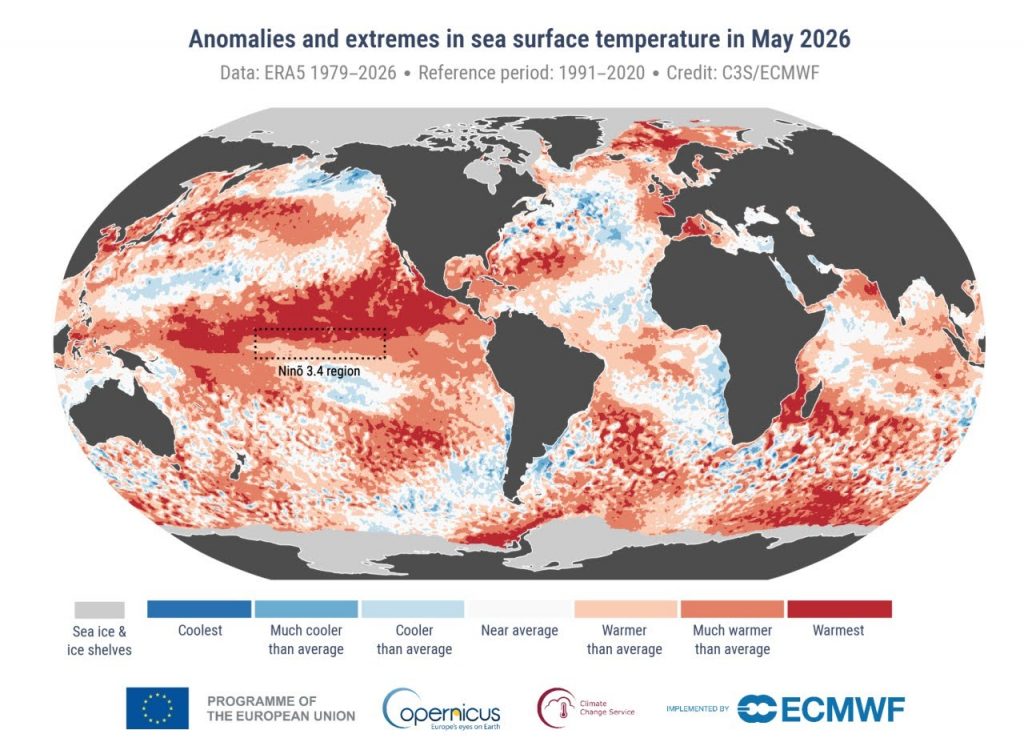
Source: The Copernicus programme
El Niño is a natural climate pattern characterised by temporary warming of surface waters in the central and eastern equatorial Pacific Ocean. Under normal conditions, strong trade winds blow west across the equator, pooling warm water toward Asia. During an El Niño event, these trade winds weaken. This allows the warm water to shift back eastwards toward the Americas (see image above), a shift that disrupts atmospheric circulation and alters the path of the jet stream.
This phenomenon occurs every two to seven years and typically lasts about a year. Because of the immense amount of ocean heat released into the atmosphere during the cycle, it raises global temperatures, with the most severe impacts usually felt in the year following its onset.
What makes the 2026 event different?
What sets this year’s event apart is the baseline it is building upon:
- Elevated global baselines: Long-term climate trends have already pushed global average temperatures to roughly 1.4°C above pre-industrial levels.
- The super boost: The developing super El Niño is projected to add another 0.2°C to that already elevated baseline.
- Historic scale: Leading meteorologists describe this event as sitting at the absolute upper end of the historical range, with the Met Office warning it could become the strongest single El Niño event so far this century.
Against the backdrop of global warming, it acts as a severe hazard multiplier, intensifying and compounding existing weather variability, creating unprecedented operational challenges for businesses.
The hygiene risks for UK business premises
Super El Niño-induced extreme weather creates urgent operational and hygiene hazards. Facilities managers need to address these escalating risks.
- Flooding and water ingress: Floodwater (Category 3) is a biohazard containing pathogens and sewage. Standard cleaning is insufficient; specialist, protocol-driven decontamination is required for staff safety and regulatory compliance.
- Mould proliferation: Warm, humid conditions can accelerate mould growth hidden behind cladding, in ventilation systems, and beneath flooring. Cosmetic solutions fail to address the root cause, and professional remediation is necessary to prevent health risks and audit failures.
- Ventilation and extraction stress: Increased kitchen throughput during heatwaves accelerates grease accumulation in ductwork, shortening the window for TR19 compliance and elevating fire risks.
- Drainage and grease trap failure: Rainfall and peak trading volume can overwhelm drainage infrastructure. Proactive surveys and increased service intervals are essential to prevent overflows, odour issues, and environmental health incidents.
- Accelerated bacterial growth: Higher ambient temperatures speed up pathogen multiplication on surfaces. In high-footfall or clinical settings, specialised disinfection (e.g. electrostatic) is critical, especially when routine cleaning is stretched.
- High-level contamination: Storm damage often pushes contaminated materials into inaccessible areas, such as roof voids and ductwork. These ‘silent’ risks require specialist access equipment to inspect and remediate before they compromise the building.
These risks are foreseeable. Identifying them early and maintaining standards are crucial to reduce hygiene and compliance issues caused by future climate instability.
Key business sectors at risk
The following sectors face disproportionate operational and compliance risks due to their regulatory environments and reliance on climate-sensitive infrastructure:
- Food production and processing: Acute risk of Category 3 flood contamination requiring full specialist decontamination to resume legal production and maintain BRCGS/FSA compliance.
- Hospitality and catering: Accelerated grease accumulation in extraction systems during heatwaves, shortening TR19 compliance windows and increasing fire/drainage failure risks.
- Healthcare and care settings: Critical hygiene demands in clinical environments; risks include ventilation-borne mould and the need for rigorous, auditable disinfection protocols to protect vulnerable populations.
- Facilities management: Scaling emergency responses across portfolios; requires proactive drainage surveys and established mould remediation protocols to prevent tenant disputes and structural damage.
- Education: Inflexible academic deadlines make rapid post-flood decontamination essential; warm, humid conditions also drive mould growth in ageing ventilation infrastructure.
- Industrial and manufacturing: Large-scale drainage vulnerabilities and high-level contamination risks; requires specialised reinstatement to meet pharmaceutical or food-grade safety standards.
How can specialist hygiene services protect your business?
When it comes to weather patterns as volatile as the 2026 “Super” El Niño, business continuity relies on a fundamental shift from a reactive mindset to one of proactive defence. Waiting for a flash flood to submerge your stockroom or a heatwave to overwhelm your kitchen ventilation will always cost more in downtime, lost revenue and insurance premiums than preventative action.
Partnering with a professional provider such as Rentokil Specialist Hygiene allows you to divide your business defence into two clear operational strategies: proactive resilience and reactive recovery.
Phase 1: Proactive resilience
Preventive maintenance is one of your shields against the weather extremes projected for the next year or two. By addressing vulnerabilities early, you ensure your infrastructure remains compliant and operational.
Kitchen ventilation and extraction cleaning (TR19 compliance)
- The El Niño threat: Record-breaking summer and autumn temperatures can push commercial kitchens to the absolute limit. Heatwaves place severe strain on HVAC and ventilation systems. If your ductwork is coated in fat, oil and carbonised grease (F.O.G), airflow is restricted. This causes kitchen temperatures to spike to unsafe levels, increases the risk of mechanical breakdowns and raises energy bills.
- The action: Rentokil Specialist Hygiene’s grease hygiene-trained (GHT) technicians provide industry-certified, TR19-compliant kitchen extraction cleaning. Cleaning the entire system, from the canopy to the atmosphere, eliminates fire hazards and ensures your cooling systems run efficiently when outdoor temperatures soar.
High-level cleaning and drainage maintenance
- The El Niño threat: Severe, rapid autumn storms can trigger intense downpours that dump a week’s worth of rain in a matter of hours. During extended dry summers, leaves, dust and debris can compact into a hard crust in gutters and high-level drainage systems. When heavy autumn storms arrive, these blocked systems are prone to immediately overflowing.
- The action: Scheduling professional high-level cleaning and gutter clearance ensures that external drainage tracks are completely clear, allowing buildings to safely divert massive volumes of water away from the roof and foundations.
Pre-emptive mould remediation
- The El Niño threat: An unusually humid, wet and mild start to winter creates ideal conditions for airborne spores to thrive. The mild, moisture-heavy winter air hastens the spread of toxic black mould in properties, posing risks to regulatory compliance, such as Food Standards Agency ratings and housing safety guidelines, and to staff health.
- The action: Rather than painting over the problem, a professional mould removal service targets the root cause. Using specialised mould eliminators and sanitisers alongside air purification units (which destroy 99.9% of airborne mould spores), specialist technicians can safely eradicate fungal growth and protect building indoor air quality (IAQ) before winter sets in.
Phase 2: Reactive recovery
Even with the best preparations, extreme weather can breach defences. If your business is impacted by a localised weather event, your priority is to minimise operational downtime.
24/7 Flood and water damage restoration
- The El Niño Threat: Flash flooding that breaches ground floors, ruins stock and halts business operations. When localised flooding occurs, every hour your doors are closed costs money. Water must be pumped out immediately to prevent permanent structural rot, warped flooring and structural undermining.
- The Action: Rentokil Specialist Hygiene operates a 24/7 UK emergency flood response, deploying local, Royal Society for Public Health (RSPH) accredited technicians within the hour. Utilising industrial-grade puddle pumps and heavy-duty wet-dry vacuums, teams rapidly extract water, clear unsalvageable debris, and install advanced dehumidifier units to safely and efficiently dry the property fabric.
Sewage backup & biohazard disinfection
- The El Niño threat: Overburdened urban drainage systems overflow, causing raw sewage to back up into commercial basements, kitchens and washrooms. Floodwater is rarely clean; it often carries dangerous pathogens, pollutants and raw sewage. This poses a severe biohazard, making your premises legally unsafe to occupy.
- The action: Specialist teams provide deep sewage cleanup and biohazard sanitisation using specialised solutions (like Steri-7) that reduce bacteria, fungi, and viruses by up to 99.9999% on surfaces. Crucially, they provide full hazardous waste consignment notes and a post-clean verification report. This formal audit trail gives your insurers and local health inspectors the exact documentation needed to declare your premises safe to reopen.
Time to be proactive
The 2026 El Niño is already underway, and its effects will inevitably test the infrastructure of UK businesses. Rest assured, the hygiene risks it generates, flooding, mould, drainage failures, surface contamination and ventilation loading, are manageable with the right partner and the right preparation.
By securing a planned preventative maintenance schedule and establishing a priority emergency response protocol now, you can insulate your business from the worst of the climate cycle’s hygiene and structural risks.
FAQs
El Niño is a natural climate pattern characterised by the warming of Pacific Ocean surface waters. The 2026 event is projected to be one of the most intense on record, adding 0.2°C to an already elevated global temperature baseline. For UK businesses, this translates to increased weather volatility, including extreme heat, storms and intense rainfall, which directly creates operational and compliance risks on the ground.
Extreme weather can pose significant hygiene threats, including flooding (which introduces Category 3 biohazards such as sewage and pathogens), accelerated mould growth in humid conditions, increased grease accumulation in kitchen ventilation systems during heatwaves, and drainage failures due to overwhelmed infrastructure.
Sectors with rigorous regulatory standards or heavy reliance on climate-sensitive infrastructure face the highest exposure. This includes food production and processing, hospitality and catering, healthcare settings, facilities management, education, and industrial manufacturing sites.
Adopting a proactive strategy means scheduling preventative maintenance before risk periods arrive. This encompasses TR19-compliant kitchen extraction cleaning, expert high-level drainage clearance, early mould remediation, and routine deep-cleaning to keep infrastructure compliant and operational ahead of severe weather.
If preventative measures are breached, services such as 24/7 emergency flood response, industrial-grade water extraction, and biohazard sanitisation for sewage backups are essential. These services help restore premises safely and provide the necessary audit trails for insurers and health inspectors.