

(Reading time: 5 minutes)
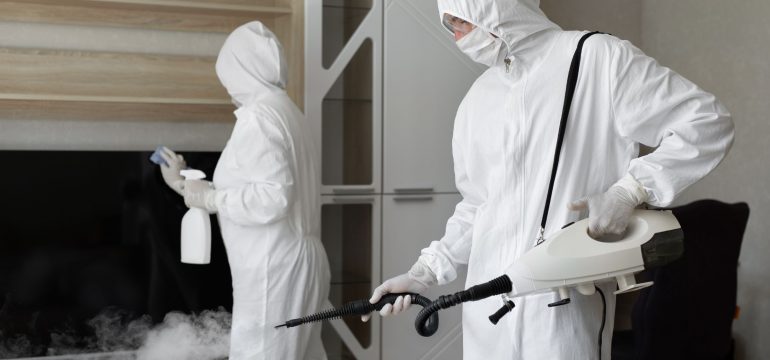
Biological hazards in secure custody environments range from small-scale contaminants, such as blood smears on a booking desk, to the large-scale fouling encountered during dirty protests.
They pose an extreme and legally accountable risk to the health and safety of detainees, prison and police officers, custody suite staff and medical personnel. Effective mitigation requires a high-level biohazard remediation process, not standard cleaning. This critical service can only be provided by specialists operating within a rigorous legal and clinical framework to decontaminate facilities and ensure statutory compliance.
This article covers:
- The security requirements for cleaning custody environments
- The legal framework and statutory obligations for cleaning biological hazards
- A step-by-step guide to decontaminating biohazards from dirty protests
- How to deal with smaller “dirty” incidents
- Ensuring best practice and legal compliance for biohazard remediation after a dirty protest
The security requirements for cleaning custody environments
One of the most significant challenges in managing a dirty protest is the unique nature of the environments in which they generally occur. Whether it’s a high-security prison wing or an urban custody suite, these are secure perimeters designed to keep people in and unauthorised items out. Unlike a public office or a retail space, you cannot simply call a local cleaning company or a standard commercial “biohazard” team to resolve the issue, as there will be specific operational barriers that standard cleaning services are not equipped to handle:
- Vetting and clearance: Any personnel entering the suite or wing must have the appropriate security clearance (such as NPPV3 for police or CTC for prisons). A standard cleaning crew lacks the background checks required to step foot behind the “yellow line”, meaning the responsibility often falls back on untrained internal staff if a specialist partner isn’t already in place.
- Contraband control: The tools of the cleaning trade, such as scrapers, chemical bottles, long-handled mops, and even the buckets, are potential weapons or “tools for escape” in the wrong hands. Every item brought into the secure zone must be logged, tracked and strictly controlled.
The legal framework and statutory obligations for cleaning biological hazards

A complex web of legislation governs the management of dirty protests and smearing incidents. The primary objective for the Police and the Prison Service is to balance the health and safety of their employees with the human rights and duty of care owed to the person in custody.
Failure to navigate these legal responsibilities could result in civil litigation, HSE prosecutions or “Article 3” human rights claims.
1. Health and Safety at Work Act 1974 (HASWA)
This is the foundational legislation for staff protection. Under HASWA, the Police or Prison Service has a non-delegable duty to ensure, so far as is reasonably practicable, the health, safety and welfare of their employees.
- Risk assessment: Management must conduct a “dynamic risk assessment” for every incident. If staff are ordered to enter a contaminated cell without the correct training or PPE, the organisation is in breach.
- Safe System of Work (SSOW): There must be a documented procedure for managing, cleaning, and returning a “dirty” cell to service.
2. COSHH Regulations 2002
Human waste is classified as a “biological agent” under the Control of Substances Hazardous to Health (COSHH) regulations.
- Assessment of exposure: Employers must identify the specific risks (e.g. hepatitis B/C, HIV, norovirus) and implement controls to prevent exposure.
- Vaccinations: While an employer cannot force a staff member to be vaccinated, they have a legal responsibility to offer and fund hepatitis B immunisations for any personnel likely to come into contact with bodily fluids.
3. The Human Rights Act 1998
This legislation protects the person engaging in the protest. The most relevant section is Article 3: Prohibition of torture, inhuman or degrading treatment.
- Cell habitability: While a person may choose to foul their cell, the state has a “positive obligation” to ensure they do not remain in a state of squalor that reaches the threshold of “degrading treatment”.
- Forced cleaning: Management must balance the need to clean the cell (for the detainee’s health) with the use of force. If a detainee is left in a fouled cell for an extended period without any attempt to remediate the environment, the service may be found to have breached Article 3.
4. PACE (Police and Criminal Evidence Act 1984) – Code C
Specific to police custody suites, Code C dictates the minimum standards for the detention, treatment, and questioning of persons.
- Fitness for detention: A cell must be adequately heated, cleaned, and ventilated. If a cell is fouled, it is technically unfit, and the sergeant must decide whether the detainee needs to be moved or whether the cell can be cleaned while they remain in it (which is rarely safe).
- Medical treatment: Because smearing in custody is often linked to mental health or drug use, the legal responsibility shifts to providing a forensic medical examiner (FME) or healthcare professional to assess the detainee immediately.
5. Environmental Protection Act 1990
This covers the disposal of the waste generated during the cleaning.
- Duty of care (Waste): The service is legally responsible for ensuring that all Category B clinical waste is disposed of via a licensed contractor. You cannot simply wash faecal matter into the standard drainage system if it contains high-risk chemicals or bulk solids; it must be bagged and incinerated in accordance with hazardous waste manifests.
6. The Reporting of Injuries, Diseases and Dangerous Occurrences Regulations (RIDDOR)
These regulations place significant legal duties on employers, such as the police and prison services, to report specific high-risk incidents occurring on their premises to the Health and Safety Executive (HSE).
- Reporting biological exposure: If a member of staff is accidentally exposed to biological material likely to cause severe human infection, it may trigger a RIDDOR report under the “Biological Agents” category. If an employee contracts a disease such as hepatitis B or norovirus as a direct result of work-related exposure to bodily waste, it is a reportable condition.
- Physical injuries during clean-up: Manual handling and bulk removal of waste can result in reportable injuries, such as a needlestick injury. If a staff member suffers an injury that results in them being away from work for more than seven consecutive days, it must be logged
- Impact on operational protocols: Custodial managers must maintain a meticulous audit trail for every incident, including minor ones, by accurate recording, to show that health and safety procedures are being followed.
A step-by-step guide to decontaminating biohazards from dirty protests
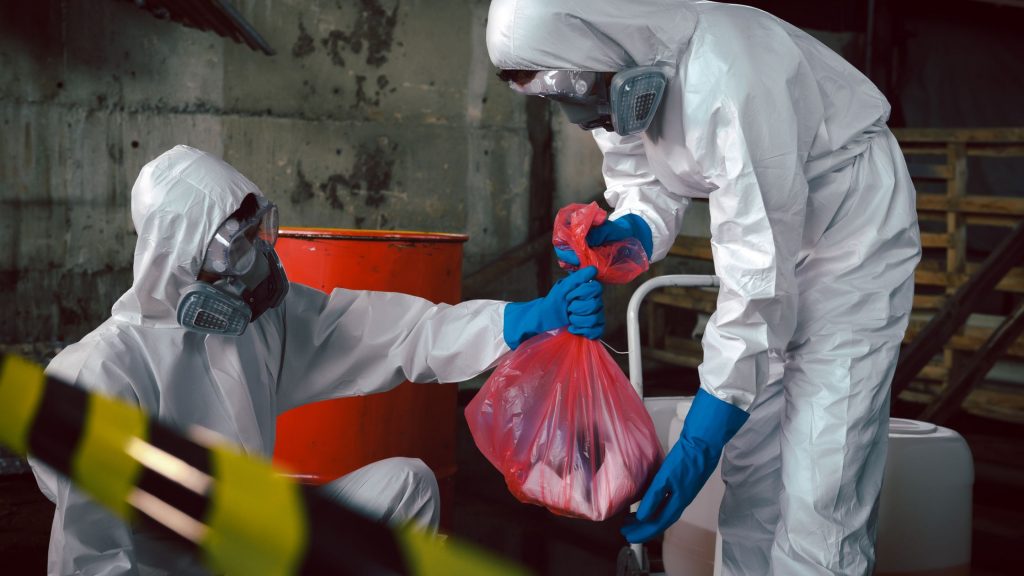
Cleaning a “dirty protest” cell is a specialist operation. It should never be attempted with domestic cleaning tools, as these can actually spread pathogens via aerosolisation or cross-contamination. The UK Health Security Agency has issued detailed infection prevention and control guidelines for prison settings.
Professional remediation teams use a multi-stage approach to restore the cell to a safe condition.
Phase 1: Preparation and dynamic risk assessment
Before any action is started, the environment must be controlled.
- Isolate the ventilation: Switch off the cell’s HVAC/air extraction to prevent faecal particulates from entering the wider facility’s ducting.
- External cordon: Establish a “clean zone” and a “dirty zone” outside the cell door. This prevents staff from tracking biohazards into the booking area.
- PPE inspection: Two-person “buddy system” check of Category 3 PPE (Type 5/6 suit, FFP3 respirator, taped gloves and face shield).
Phase 2: Bulk removal (the “dry” phase)
The goal here is to remove the mass of organic matter without creating “splatter” using specialised tools.
- Manual clearance: Use non-porous, disposable scrapers to remove solid waste from walls, ceilings and the plinth.
- Hazardous waste bagging: All solids must be placed immediately into yellow “Category B” clinical waste bags and double-bagged.
- Initial deodorising: Apply a molecular odour neutraliser. Avoid “masking” scents, as they can mix with waste odours and cause nausea among staff.
Phase 3: High-level disinfection (the “wet” phase)
- Saturation: Spray all surfaces with a broad-spectrum virucidal disinfectant. Leave for the specified contact time (usually 10–20 minutes) to eliminate bloodborne pathogens.
- Agitation: Use stiff-bristled brushes to scrub “anti-pick” mastic joints, door hinges and the underside of the toilet rim where waste is often hidden.
- Steam or low-pressure wash: If necessary, use a dry-steam cleaner (120°C) to thermally kill bacteria in porous concrete. Avoid high-pressure jet washes as these create dangerous bio-aerosols.
Phase 4: Niche area cleaning
- The “hidden” spots: Deep clean the cell call bell, the light diffusers, and the observation “wicket” (the sliding hatch). Waste is often smeared into these mechanical parts to disable them.
- Ventilation grilles: Remove and soak grilles in disinfectant; vacuum the first 12 inches of the ducting with a HEPA-filtered vac.
Phase 5: Verification and handover
- The UV blacklight check: Use a UV torch to identify any remaining organic traces (proteins/fluids) that are invisible to the naked eye.
- ATP testing (optional but recommended): Use an ATP swab test to scientifically prove the surface is biologically clean.
- Document and seal: Complete the post-decontamination paperwork. The cell should remain empty for at least 30 minutes to allow any remaining aerosols and vapours to dissipate before a new detainee is introduced.
How to deal with smaller “dirty” incidents
For smaller incidents in a custody suite, sometimes called “minor smearing”, a Biohazard Spillage Kit (or “sharps and body fluid kit”) is the essential first-response tool.
Having these pre-packed and accessible allows staff to contain the risk immediately without waiting for a specialist external team, while still maintaining the high safety standards required by COSHH.
The biohazard spillage kit checklist
This kit should be stored in a durable, yellow, wall-mountable case or a portable grab-bag. Note: All items must be single-use and disposable.
1. Personal protective equipment (PPE)
- Nitrile gloves: High-thickness, powder-free (enough for double-gloving plus a spare pair).
- Disposable fluid-repellent apron: To protect clothing from splashes.
- FFP3 respirator mask: Even for small smears, aerosolised particles are a risk.
- Eye protection: Indirectly vented goggles or a disposable face shield.
2. Cleaning and neutralising agents
- Absorbent granules: Specifically for solidifying liquid waste (urine/vomit) into a manageable gel.
- Chlorine-release tablets or spray: Must be effective against hepatitis B, HIV and norovirus.
- Biohazard wipes: Heavy-duty, disinfectant-saturated wipes for surface “spot cleaning”.
- Odour neutraliser spray: A professional-grade spray that breaks down molecules rather than masking them.
3. Application and removal tools
- Disposable scoop and scraper: For “bulk” removal of solidified waste without manual contact.
- Clinical waste bags (yellow): Marked “Hazardous Waste” with integral tie-closures.
- Anti-bacterial hand wipes/sanitiser: For use after PPE removal.
4. Documentation and safety
- “Cell Out of Use” signage: To prevent accidental entry before the disinfectant has met its required contact time.
- Instruction card: A laminated, step-by-step guide (pictograms are best) on the correct order of donning and doffing PPE.
Rapid response protocol (the “small smear” method)
Even with a small incident, staff should follow this “short-form” protocol:
- Put on PPE: Mask and goggles first, then apron, then double gloves.
- Apply granules: Cover any liquid/semi-solid waste. Wait 2 minutes for gelling.
- Scoop and scrape: Remove the bulk and place it directly into the yellow bag.
- Disinfect: Apply the chlorine-release agent to the area and leave for the manufacturer’s recommended “contact time” (usually 5–10 minutes) before wiping away.
- Seal and dispose: Place all tools, wipes, and PPE (apron/gloves) into the yellow bag. Double-bag it and secure it for clinical waste collection.
- Handover: Record the incident in the custody log, noting the chemical used and the time the cell was treated.
Ensuring best practice and legal compliance for biohazard remediation after a dirty protest
Managing biological hazards in custody suites, whether from a minor smear or a full-scale dirty protest, is a non-delegable and legally accountable risk. Custodial environments are governed by a complex and rigorous legal framework, including the Health and Safety at Work Act (HASWA), COSHH regulations and Article 3 of the Human Rights Act. Because of the severe risks posed to detainees, prison and police officers, custody staff and medical personnel, compliance with these statutory health and safety obligations is strictly mandatory, not optional.
Standard cleaning methods and simple visual inspections are no longer tenable in these high-risk scenarios, as incorrect procedures can actually spread dangerous pathogens through cross-contamination or aerosolisation. Instead, custody suites must shift toward a measurable, “verified” cleaning approach. This requires executing a multi-stage decontamination protocol and utilising scientific validation, such as ATP swab testing, to unequivocally prove that a surface is biologically safe. Furthermore, future custodial safety relies on integrating advanced engineering controls, such as specialised forensic air-handling systems and non-porous materials, to proactively reduce the need for heavy chemical interventions.
Given the extreme health risks, the pressure of keeping cells operational, and the strict security perimeters of police and prison facilities, relying on standard commercial cleaners or untrained internal staff is inadequate and legally perilous. Therefore, it is highly recommended to partner with vetted, professional biohazard remediation experts, such as Rentokil Specialist Hygiene. By employing specialised cleaning services equipped to operate within tight clinical and security frameworks, police and prison services can ensure immediate and safe decontamination, maintain critical operational flow, and confidently uphold their legal duty of care to everyone in the facility.